Monday, June 3, 2013

The Absolutely True Diary of a Part-Time Indian

Subject: Junior is an adolescent teenage Indian who was born with water on the brain. As if being a freshman in high school isn't hard enough, Junior gets beat up on a daily basis and constantly struggles with the fact that he will grow up to be poor and drunken just like most of the other indians on his reservation. Sometimes all he has keeping his sanity in check are his cartoons and his best friend Rowdy, a tough brute of a boy who secretly has a warm heart. 

The day that Junior realizes that him and his geometry class are using the same text books as their parents, he finally cracks. After he chucks the book at his teacher's face he realizes that he needs to get away from his reservation, and fast. He decides to do what no other Indian has ever done and transfers to Reardan High School, a white, rich-kid school outside of the reservation. 

Though it takes a few months, Junior eventually adjusts to the new atmosphere. He even manages to snag the most popular girl in school, Penelope, as his girlfriend, and becomes a star on the varsity basketball team. As Junior becomes more accustomed to his new life, he struggles to figure out who his real friends are and who, ultimately, he is. 

Through moments of extreme isolation and experiencing too many losses in a small period of time, Junior learns total perseverance and is able to recognize the things that mean the most to him in his life. 

Occasion: This was author Sherman Alexie's first novel. He writes based on experiences from his teenage years living on an Indian reservation. He may write this on the occasion that few people really know about the struggles faced on reservations and he wants to inform people about this issue. 

Audience: Based on the simple vocabulary, the entertaining cartoons, and the contents which is only capable of a teenage boy, I would guess that this light-hearted, humorous novel is written for preteens and teens. With that said, it's a fun read and I think most adults would enjoy it as well. It could also be targeted for children and teenagers on Indian reservations who feel that their situation is unchangeable. Junior, or more realistically Sherman Alexie, is the perfect example of a Native-American who was able to escape the normalcies of the reservation. 

Purpose: I believe that Alexie wrote this novel mostly for the sake of entertainment. Reading it is thoroughly engulfing and at times hilarious. Getting inside the head of self-conscious and relatively nerdy teenage boy is bound to be funny. As I said before, Alexie may have also written this book to educate the public about the struggles of being an Indian living on a reservation tied down by poverty and alcoholism. 

Style: Alexi uses many short, simple sentences throughout the book. His style is very informal and adolescent. Throughout the story, Junior jumps from experience to experience, sharing his thoughts. The first sentence of the book pretty much sums up what the rest of the book is like. "I was born with water on the brain." Alexi's diction is simple and in some cases colloquial. It does a great job capturing the essence of a teenage male.

Tone: Alexi's tone in The Absolutely True Diary of a Part-Time Indian is  sarcastic and very diary-like. Junior doesn't hide anything. When he writes he isn't of getting into the nitty-gritty details. However his writing is only-skin deep, never making the reader feel Junior's emotions. This is most likely because Junior is very blunt about death and other serious losses. It may also be because Junior finds the humor in every situation he experiences, that is why this is a fun book to read. Alexi could have taken a way more depressing approach considering all of the sad things that happen throughout the book, but he chooses to write through Junior who is a teenage boy with teenage boy thoughts and an overall light-hearted tone. 

On a scale of 1- nerdy preteen I would give The Absolutely True Diary of a Part-Time Indian a nerdy preteen for it's wittiness and pure entertainment. 

Thursday, March 21, 2013

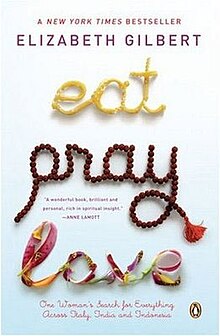
Eat Pray Love


When I was 13 years old, I got my fortune told by a little old man in Bali, Indonesia. With a one-toothed grin he took my hand and examined it. Although I don’t remember everything from my fortune, I remember he told me, in what English he knew, that I would get married once and have two children. He told my grandma that she would live to be one hundred seven, or was it one hundred three? We were never quite sure. We were both satisfied with our apparent futures afterward, but we were more excited that we had just met the most famous fortune teller in Bali, the same one who had taken the fortune of Elizabeth Gilbert, the author of Eat, Pray, Love only a few years earlier.
Liz Gilbert was stuck. After recently leaving a nasty divorce and having her heart broken  in a head-over-heals affair, she needed to do something to get away, to find herself. And what better way to accomplish this than by traveling. In the course of a year, Liz went on an exciting, heart-felt journey to Italy, India, and Bali learning many valuable lessons along the way. 
At the beginning of Eat, Pray, Love, Gilbert shares the dark time in her life after her divorce. Her melancholy tone makes it a relatively depressing start, but it’s obvious that the plot will look up. During this rough patch in her life, Liz got the chance to have her fortune told by that little old man in Bali. He said that she would lose all her money, but get it back soon, that she would get married again and added that she should come visit him in Bali and help him with his English. This sparked a new idea in Liz’s mind. She had been itching to go to Italy and learn Italian, but also wanted to go to India and master the art of meditation, and now she wanted to go to Bali too. She decided not to choose between them and to spend a year traveling to all of these magnificent places, and so the story began. In Italy Liz would discover the importance of pleasure; in India she would discover the power of God; and in Bali she would realize the capacity of the human heart and the love of self. 
Subject: This book is in itself almost a fairytale, a first-account look at traveling to beautiful places and enjoying yourself. But, more importantly this story is about self discovery and appreciating the small joys in life. It is a unique story because it is about doing exactly what your heart desires, something that is very difficult to do in today’s day and age. It is inspiring and could also pass as a self help book. 

Occasion: Liz’s story begins in New York City around the time that the World Trade Center was hit. This devastating event coupled with her divorce and severe depression lead to the occasion of this book being written. Being a writer, traveling the world for one year straight and experiencing a life changing journey was the perfect thing to write about.

Audience: If there is an intended audience for this book, it’s not obvious. It is simply a nice, personal story of perseverance. However, I think that the content of the book would appeal most to older women who are feeling stuck and are in need of a little push in order to become unstuck. I know that both my mom and grandma read this book and really enjoyed it. I read it and enjoyed it but couldn’t relate as well to the marriage aspect or the overall stress of an adult’s life. I also think that travelers would be drawn to this book just by the vivid, colorful descriptions of the beautiful destinations described. Anyone who loves traveling would appreciate the passion that Liz  has for going to new places and the wisdom she gains from new experiences. Finally, I think that religious people would like this book. Particularly people who are not strictly in one religion, but are interesting in many and have a strong belief in God. The author spends a lot of time describing her spiritual experiences and how God helped her persevere. But regardless, anyone who likes a soul-searching traveling story, will like this book. 

Purpose: I think the purpose of Liz Gilbert writing this book was to document her experience and give readers hope that they can turn their lives around. Eat, Pray, Love may also have given people a new vacation destination or two. It’s also an engaging storyline and could be read solely for entertainment.

Style: Elizabeth Gilbert uses relatively informal language throughout the book. While reading it it’s almost as if Gilbert is a friend of yours telling you a crazy story. She also has a biblical style when she delves into a spiritual topic. The structure of her writing is very unique. The subject jumped around a bit and every once in a while Gilbert would go on a tangent about a random side-story or history of an Italian word. She also used an abundance of parenthesis either for humor or to add an extra detail that really wasn’t necessary. The writing was also very verbose on occasions, almost to the point where the reader skips to the next page because it’s so redundant. Overall, a fun, easy read that holds the reader’s interest the majority of the time.

Tone: While the tone is light-hearted and fun, there are times when Gilbert comes off as self-centered. Because the writing is from her point of view and she is telling her story it makes sense that she should share her opinions, but in some cases he shares her opinion too strong, or comes off as being self-righteous. On the other hand, her added jokes and thoughts make her and the book more likable.  

In conclusion, I give this book a 4 out of 5 and would recommend this book to anyone looking a fun story.


-Katut Liyur the fortune teller


Thursday, January 10, 2013

In Pursuit of Excellence

Let me tell you something-- I’ve never gotten last place before. Or at least not in anything that mattered enough for me to care. I would joke about getting last place, just like any average athlete would do. “Well as long as I don’t get last... hahah” And my friends would laugh with me.  
That is, I had never gotten last until last Wednesday at Cross-country Skiing Nationals. When, here it goes: I got last. Yep, that’s right, bottom of the list, down by the sponsor’s logos and the date in which the results were printed. D.F.L. 
It’s a bad feeling. Even if you swear you don’t care about the results, you promise you are just racing for fun, it hurts. I fell and skidded on my behind on probably the worst possible place to fall in a 3 minute, 1 kilometer race. Nobody else fell. My fault, but even the best fall down sometimes, right? Wrong. I was devastated. How could I have been so unfocussed, so clumsy? Especially after all of the hours and hours of work I have put into ski racing? I needed some motivation, and fast.  
That night my mom handed me the book In the Pursuit of Excellence by Terry Orlick as an early birthday present, (my birthday was the next day). She said that this was the book that the U.S ski team coach had recommended his athletes to read. Reluctantly, I opened it and read the first few pages. 
It immediately dove into topics like motivation and focus, subjects that I was lacking at the time, and quite honestly I didn’t want to hear about amazing people who did amazing things because of their amazing dedication and focus. I wanted to hear about another person who skidded on their behind in a big race, got last, but then came back to be amazing. But slowly, once the “feel bad for myself” phase had worn off a little, the book began to grow on me. 
Terry Orlick is a world renowned sports psychologist who used to be a professional gymnast. His book In Pursuit of Excellence is the perfect guide for athletes who have a big goal in mind, in fact it’s good for anyone who has any goal in mind. First it talks about the wheel of excellence. This wheel contains seven sections and when all the parts are working and in harmony, you will be able to excel at anything, Orlick believes. The wheel looks something like this: circled around the outside edge lies the components: positive images, mental readiness, distraction control, and ongoing learning. Around the center of the wheel lies commitment, focussed connection, and finally, confidence. Throughout the book, Orlick goes into very fine detail on all of these subjects. He talks about everything from goal setting to the zen zone, and even has a chapter on getting through and learning from set backs, which I eagerly flipped to when I first got the book.  
This book is wonderful. I don’t know about all athletes, but I wonder all of the time  what it really takes to make it to the Olympics; what it really takes to be considered great. Now I know that it takes a whole lot more than an abundance of physical training, it takes an enormous amount of mental training. You need focus, intense focus. So focussed that you’re not even focussing anymore, you’re just in the zone. It also takes many goals, big and small. As Terry says, “Let’s say that you want to become the best performer you can be, or that you want to write a book. Great! What are you going to do about it in the next five minutes, hour, day, week, month, year?” (Orlick, 60) Big goals keep you on track, but small goals actually get you there. Orlick suggests that when you  wake up in the morning, you should write a list of all of the things you want to accomplish that day. This way, your goals are more concrete and you will be more motivated to get them done.  
Orlick writes this book in a suggestive, but not pushy manner. He proposes that anyone can accomplish or make significant progress towards their individual goals. He never says that you definitely can or can’t accomplish something, he lets you decide. He asks many questions regarding the reader’s dedication, focus, and goals. This makes reading the book more personal and really makes you think about how much you want to achieve your goal and if you are willing to give it your best. He writes simply and to the point. There is no beating around the bush, Orlick clearly states what it takes mentally to achieve your dreams, and the rest is up to you. 
I would recommend this book to anyone, because we all have things that we want to accomplish. When I was down in the dumps, this book helped me climb back up and realize that one bad race isn’t the end of the world. My skiing life isn’t over, the only thing that’s over is that bad race. It’s time to move on, set more goals, and go after them. I can do it, and so can you. This book is a first good step toward achieving anything. 

Rating Scale:

:,( Can’t finish the book no matter how hard I try
:( Not likin’ it. Barely finish it, but I don’t remember much
:/ It’s okay. I’ll read it if I have nothing better to do
:) Good! I would recommend it to others looking for a good book
:,D Amazing! Inspires me to be a better person

In Pursuit of Excellence gets a :,D